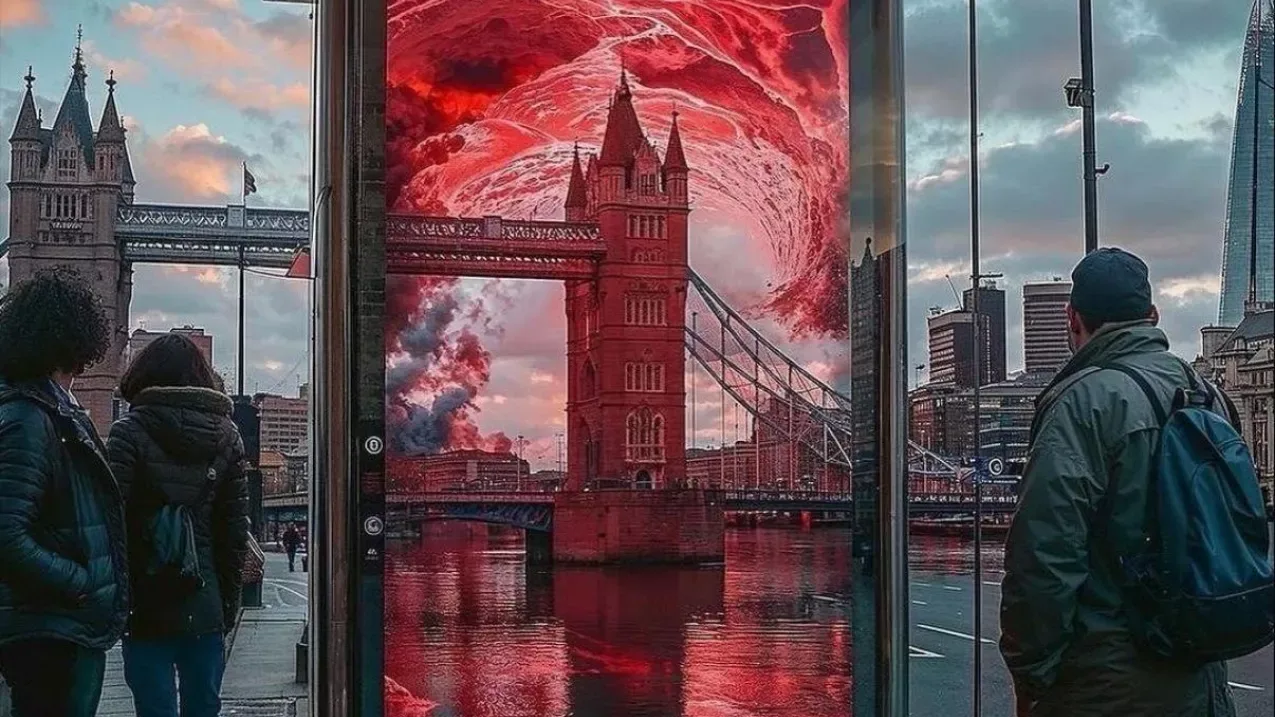
If you believed the social media photos, London was recently turned into the Upside Down from Stranger Things. There were terrifying images of Tower Bridge engulfed in the red and fiery strands from Vecna’s lair, a red bus protruding from a subway as if it were sinking into another dimension, and a horrifying giant hand smashing through a pavement.
At first glance, it looked like the marketing team at Netflix had gone all-out for a multi-million dollar real-world marketing campaign to promote the fifth and final season of Stranger Things. How did they pull this off?
But the reality was even more fascinating. None of this was real. It was all AI generated.
In fact, this activation was part of a growing trend in marketing, where fun and engaging digital images are integrated with real-world visuals, creating the illusion of a grandiose OOH campaign. Some have coined it Faux Out-Of-Home (FOOH).
As we’ve previously discussed, there’s been no little hysteria among the creative community about the perceived negative impact of AI on the industry. In many ways, this campaign could be held up as an example of how AI is gradually taking over the creative process. Why spend a fortune on building something for real if we can just get a computer to superimpose it onto a pre-existing image?
But the truth is there’s a place both for legitimate OOH activations and fun digital campaigns like this one. FOOH isn’t a replacement strategy - it’s simply another channel for us media strategists to use. When it’s done well, it gets us talking and sharing. When AI is used lazily and without thought, we ignore it. The market will ultimately always decide.
So whether these activations exist in reality or are computer generated is largely irrelevant - as long as they’re creatively engaging. Digital activations like this can enable more creativity on a smaller budget, while leading to greater reach by creating those viral moments.
The truth is that consumers are spending longer and longer on digital devices. Recent data from Comscore shows that Canadians spent 66% of their time online on mobile devices, making it the most popular category, followed by desktop (19%) and Connected TV (15%). This makes it vital that brands meet consumers where they are, while also creating exciting moments like this that lead to word-of-mouth amplification.
That said, it does still remind us of the potential power of OOH. Imagine if these HAD been real? It’s probably unrealistic to expect Netflix to cover-up Tower Bridge in such a way - and that’s before we think about whether the City of London would even allow it.
But it’s a great way to remember how impactful OOH can be when it’s done right. When we go ‘beyond the billboard’ and integrate OOH in a way that’s eye-catching and stands-out, it can be extremely impactful.
In the meantime, we can all have some fun with what Netflix did here, as well as get excited - with caution - around the opportunities to further blur the lines between what’s real and what’s digitally produced.
Are you ready to maximize your media strategy? Let’s talk.